
Quality & testing
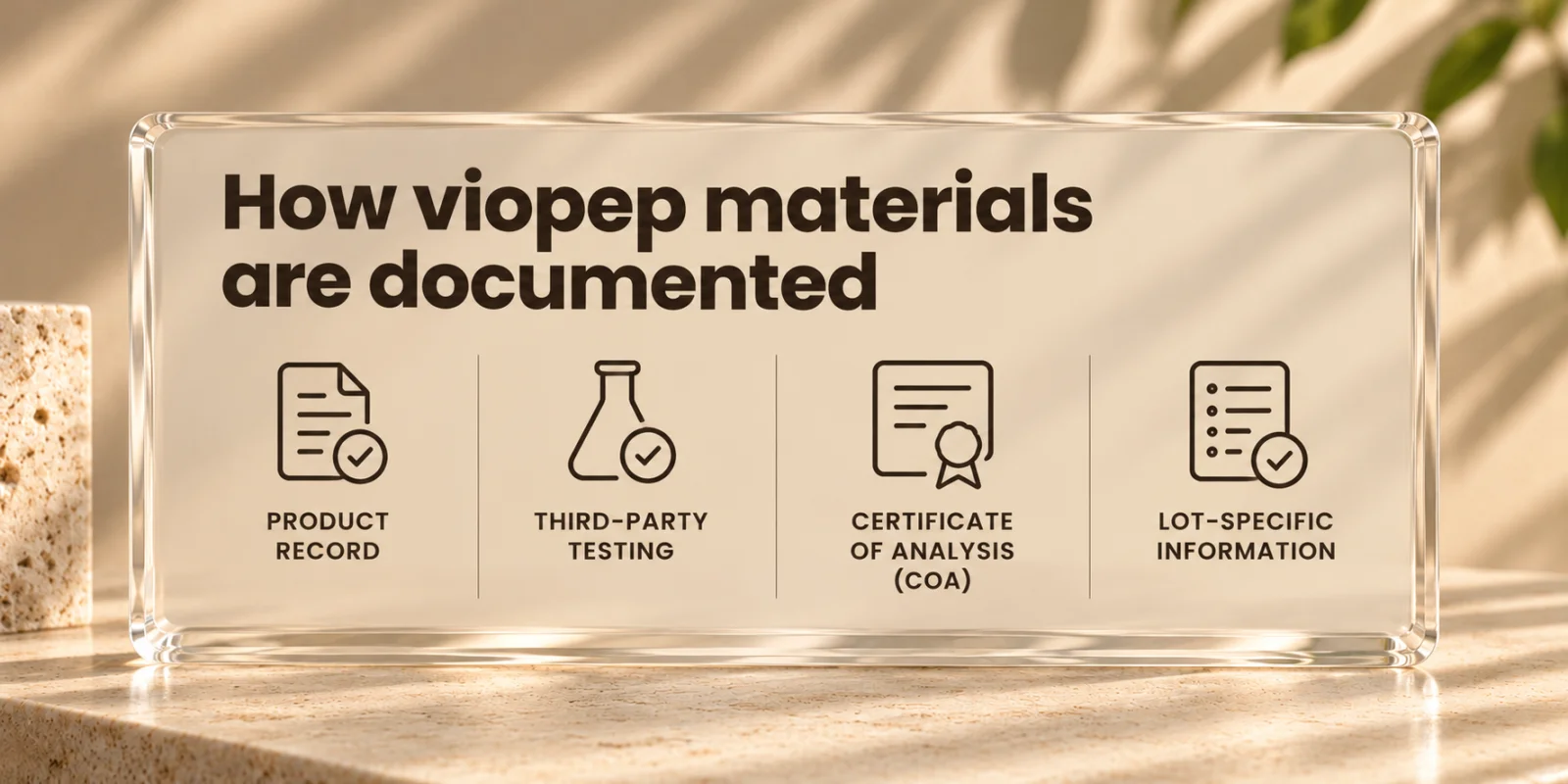
How viopep materials are documented
Trust in this category is a documentation question. This page explains what a certificate of analysis is, what the common analytical methods actually measure, and how a vial traces to the record for its own batch.
Illustrative chromatogram trace, not an assay record.
The certificate of analysis
What the document is, and the fields it carries.
- What is a certificate of analysis?
- A certificate of analysis (COA) is a document issued by a testing laboratory reporting what it measured for one specific batch of material. It ties those measurements to a lot number, so anyone holding a vial from that batch can look up exactly what the laboratory reported for it.
What a certificate typically documents
- Identity
- The compound the laboratory determined the material to be.
- Lot number
- The batch the tested sample was drawn from: the identifier that ties the document to physical vials.
- Methods
- The analytical techniques the laboratory ran to reach its findings.
- Measured values
- What the laboratory recorded, including the proportion of the intended compound detected (the figure usually read as purity).
- Date & laboratory
- When the analysis was performed, and by whom.
Analytical methods
What the common methods measure, in general terms
Two techniques appear on most peptide certificates of analysis. They are described here generally; the methods used for any given batch are stated on that batch’s own certificate.
Composition
High-performance liquid chromatography (HPLC)
HPLC separates the components of a sample by passing it through a densely packed column under pressure; different molecules travel through at different rates. The output is a chromatogram, a trace with a peak for each detected component. The relative area under those peaks is how a laboratory typically quantifies how much of a batch is the intended compound versus other detected substances.
Identity
Mass spectrometry (MS)
Mass spectrometry measures the mass-to-charge ratio of ionized molecules. Because a peptide’s amino-acid sequence determines its molecular mass, comparing a measured mass against the expected value for the compound is a standard laboratory approach to confirming identity: that the material in the batch is the compound the label says it is.
viopep educational content is provided for informational and research purposes only and is not intended to provide medical advice, treatment recommendations, dosing instructions, or guidance for human or veterinary use.
Reference
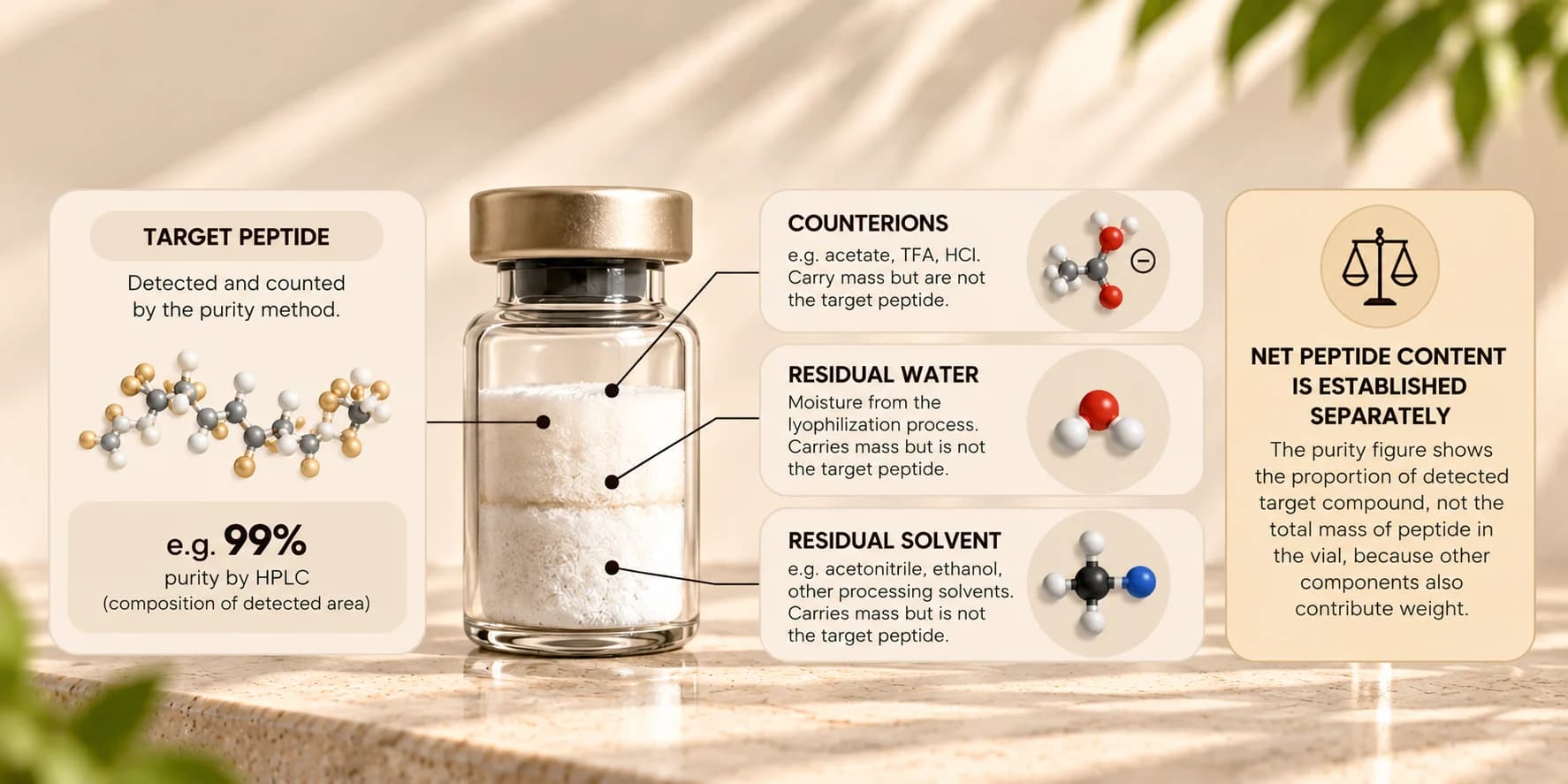
What a purity figure does not tell you
A chromatographic purity figure describes what proportion of the detected material is the target compound under one method’s conditions. It is a composition measurement, not a quantity: counterions, residual water and residual solvent all carry mass, and net peptide content is established separately.
Lot traceability
From batch to certificate
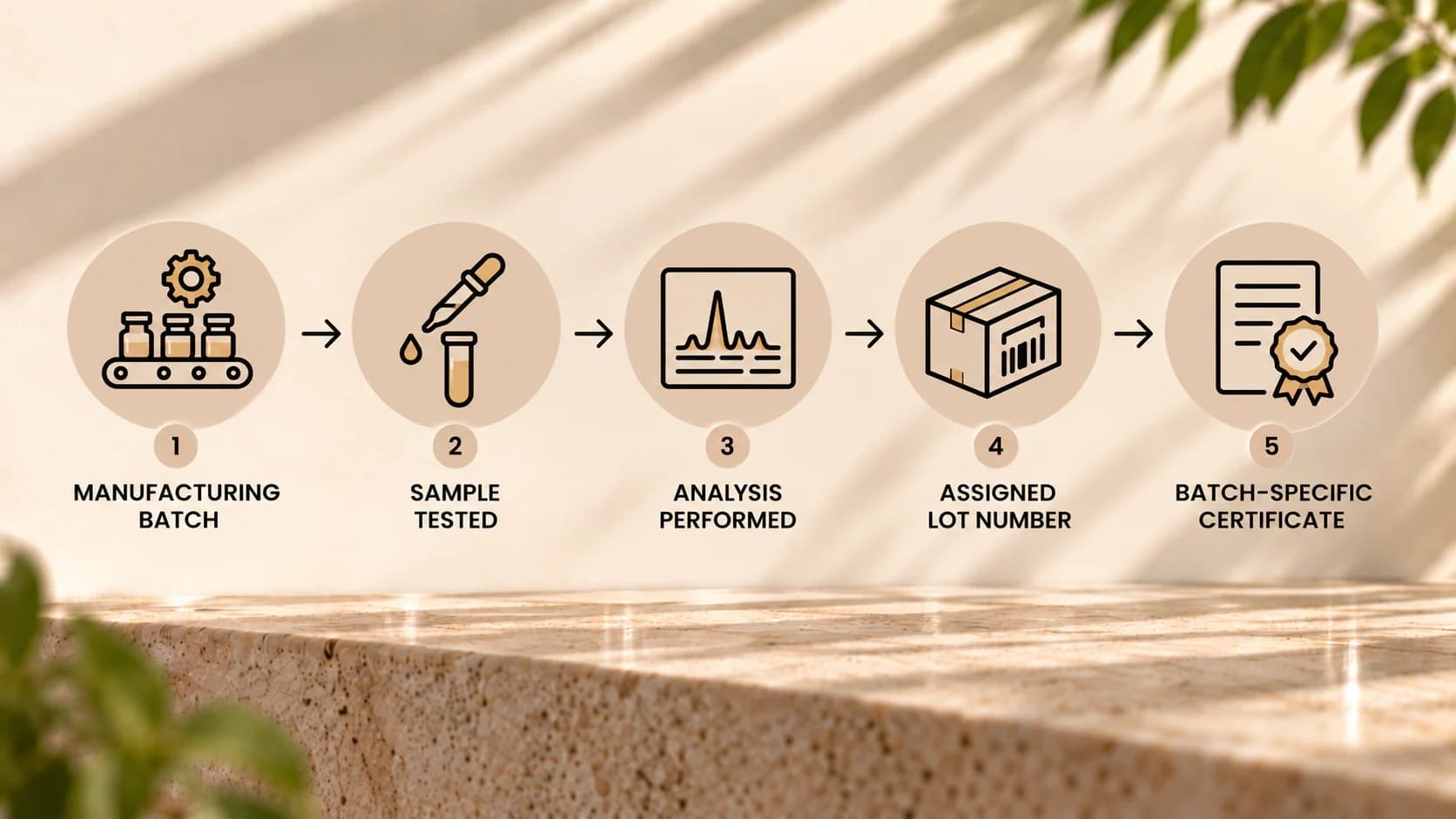
A blanket statement about a product line can’t be checked; a lot-numbered certificate can. Analysis describes only the batch its sample came from, which is why documentation that matters is batch-level, and why the sequence below runs in the order it does.
- 01
A batch gets a lot number
Material is produced in discrete batches, and each batch is assigned a lot number: the identifier that follows it through testing, labeling, and the archive.
- 02
A sample goes to the laboratory
A sample drawn from the batch is submitted to an independent laboratory for analysis, so the findings describe the batch itself rather than a reference specimen.
- 03
The laboratory reports what it measured
The laboratory issues a certificate of analysis for the lot: the methods it ran and the values it recorded. viopep publishes what the laboratory reports.
- 04
The certificate is archived by lot number
Certificates are hosted in the archive on this site, filed under the batch’s lot number, so the record stays available after its batch sells through.
- 05
A vial traces back to its record
The lot number printed on a vial’s label is the key to its documentation: look it up in the archive and compare the certificate against the vial in hand.
The record
The archive is where the paperwork lives
Certificates of analysis are indexed by lot number in the certificate archive, published as batches are released. If you hold a vial, its lot number is the way in.